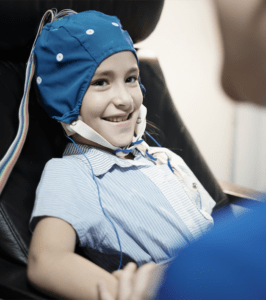
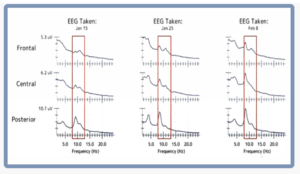
We begin with noninvasive brain mapping (qEEG) to understand how your child’s brain functions and communicates.
We also use an EKG to look at the relationship between brain and heart activity.
Call Us: 269-430-7966
A personalized, brain-based approach using customized TMS treatment
Autism spectrum disorder is complex, and no two children experience it in the same way. Because of this, finding the right combination of supports can feel overwhelming, especially when progress feels inconsistent or short-lived.
Many parents tell us they see their child’s potential but aren’t sure how to help them access it. Others have tried multiple therapies over the years, only to experience mixed or temporary results. These frustrations are common, and they’re completely understandable.
Children with autism may face challenges with communication, social interaction, emotional regulation, or repetitive behaviors. For some families, these challenges can affect daily routines, relationships, and overall quality of life, for both the child and the parents supporting them.
As children age and undergo developmental changes, behaviors may shift, and previously effective therapies may become less effective.
For families seeking a brain-based, non-invasive option, EEG-guided rTMS, also known as MeRT® (Magnetic e-Resonance Therapy), may be worth exploring as part of a broader, individualized care plan.
Or fill out the contact form at the bottom of the page.
Autism affects how different areas of the brain communicate, process information, and regulate responses. For many children, challenges with communication, attention, sensory processing, or emotional regulation are linked to how these brain networks work together.
At Brain Treatment Center Michigan, we use EEG-guided rTMS (MeRT) to better understand each child’s unique brain activity. Using non-invasive brain mapping, we identify patterns where communication may be out of sync.
This information allows us to design a personalized, brain-based treatment plan focused on supporting healthier communication between brain regions.
Rather than addressing behaviors directly, this approach works at the neurological level that underlies learning, regulation, and engagement.
Because every child’s brain is different, treatment is individualized, and experiences can vary.
Many autism therapies focus on building skills, supporting communication, or shaping behavior through repetition and practice. These approaches can be valuable and are often an important part of a child’s overall support plan.
EEG-guided rTMS (MeRT) takes a different role. Rather than addressing behaviors directly, it focuses on how the brain communicates and regulates itself at a neurological level.
This brain-based approach is designed to support the underlying systems that influence learning, attention, and regulation.
Because these approaches address different aspects of autism, MeRT is not a replacement for therapies such as ABA, speech therapy, or occupational therapy. Instead, it is often explored alongside existing supports as part of a more comprehensive, individualized care plan.
The process begins with a comprehensive evaluation to better understand your child’s unique brain activity and determine whether a brain-based approach like EEG-guided rTMS (MeRT) may be appropriate. This includes non-invasive brain mapping, along with a thoughtful review of your child’s history and current supports.
If your clinician considers MeRT to be a good fit, we will develop a personalized treatment plan based on your child’s individual brain patterns. Because every child’s brain is different, treatment plans are tailored, and experiences may vary from one child to another.
Throughout care, our team closely monitors your child’s response and adjusts the treatment protocol as needed. Families are kept informed along the way, with an emphasis on thoughtful pacing, clear communication, and individualized planning.
A core goal of brain-based autism treatment is to support how the brain communicates, regulates, and processes information. When these underlying systems function more smoothly, families may notice changes across multiple areas of daily life.
Because EEG-guided rTMS (MeRT) is individualized, experiences vary from child to child. Families often report changes in areas such as:
Greater social engagement and responsiveness
Improved communication and language use
Increased presence and participation in daily activities
Reduced anxiety, frustration, or emotional reactivity
Improved ability to cope with stress
Greater emotional stability and calm
Increased attention and focus
Improved ability to follow directions
Greater adaptability to changes in routine or environment
Increased motivation to learn
Stronger connection with others
Improved independence in daily tasks
Better engagement with existing supports and therapies
MeRT does not replace behavioral, speech, or occupational therapies. Instead, by supporting healthier brain communication, some families find their child is better able to engage with and benefit from the supports already in place.
MeRT is a highly customized version of rTMS (repetitive Transcranial Magnetic Stimulation). The science and protocols are based on years of authoritative research published in some of the most prestigious scientific journals. Here are a few examples; more studies are ongoing.
“After TMS intervention, discernible enhancements across a spectrum of scales are evident in stereotyped behavior, repetitive behavior, and verbal social domains. A comprehensive review of literature spanning the last five years demonstrates the potential of TMS treatment for ASD in ameliorating the clinical core symptoms.
“Recent findings generally indicate that TMS has positive effects on stereotypical behavior, repetitive behavior, verbal and social aspects of ASD, leading to overall improvement across all scale scores post-intervention.”
“Several rTMS trials in ASD have shown marked improvements in motor symptomatology, attention and perceptual binding.
“Conclusion: rTMS is the first therapeutic attempt at ASD aimed at correcting some of its core pathology.”
“Conclusion: This study presents evidence on the efficacy and safety of α-rTMS in improving ASD symptoms, quality of life and comorbid sleep troubles in children. However, these findings should be interpreted as preliminary pending the presentation of double-blind, randomised clinical trials.”
“TMS is a non-invasive therapeutic intervention capable of modulating evoked and induced gamma oscillations and altering maladaptive behaviors83. Recent reviews of the literature suggest that TMS is safe and effective when used in ASD.”
“The findings of this study demonstrate that high-frequency rTMS over the parietal lobe is potentially an effective strategy to improve core symptoms by enhancing long-range connectivity reorganization in ASD.”
“rTMS provides changes in connectivity and behavior, suggesting its potential use as a viable treatment option for ASD individuals.”
To find out if MeRT is the right choice for your child, begin by reaching out to our New Patient Coordinator. She can provide detailed information about the treatment, protocols, costs, and payment options. If you decide to proceed, we will schedule your initial two appointments. The first is for a noninvasive brain scan, and the second is a consultation with the doctor to discuss the scan results and potential benefits of treatment.
We begin with noninvasive brain mapping (qEEG) to understand how your child’s brain functions and communicates.
We also use an EKG to look at the relationship between brain and heart activity.
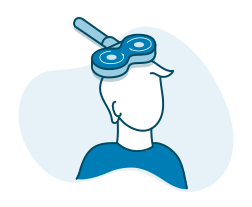
You’ll meet with a physician (in person or virtually) to review the results, discuss whether MeRT may be appropriate, and have your questions answered.
If you move forward, treatment sessions are typically about 45 minutes per day, Monday through Friday.
Each treatment plan is personalized based on your child’s brain activity.
We monitor progress throughout care, with repeat brain scans used to guide adjustments and keep treatment tailored to your child.
An episode of “The Doctors” showcased MeRT treatment for autism, highlighting its impressive outcomes. The show featured an interview with neurologist Dr. Spencer O. Miller, an expert in treating children with ASD. And a parent shared a testimonial about her child’s remarkable progress. Watch the full episode and learn more about the success of MeRT for autism treatment.
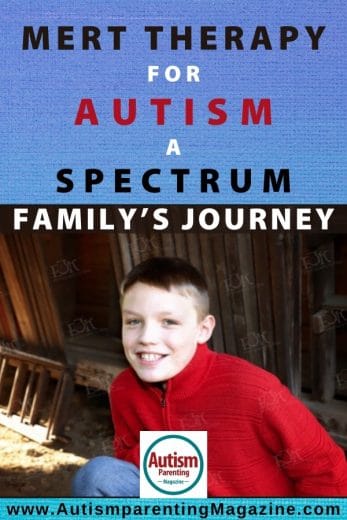
Here are a few quotes from an incredible story from the parents of Frankie, a child with autism who received MeRT treatment…
“In the third week, something happened. The family was driving around sightseeing when they realized that they were getting lost in the California desert. Mary and Frank began to argue, and right in the midst of it, the moment they had waited six years for finally came. ‘I remember he said a seven-word sentence basically to the effect of, “I want you two to stop fighting.” And it shocked me so much that I almost stopped breathing,’ Frank recounts. ‘I looked at my wife and said, “Do you realize what just happened? He just said a seven-word sentence.” I had tears in my eyes, and I was happy at the same time.’
“From there, Frankie’s progress snowballed. They returned home after only a month, but the difference between the child who arrived in California and the one who left was striking. They had taken a video of Frankie on the plane when they started the journey, ‘and he’s just making baby babble,’ Frank says. ‘We have another video of him on the plane coming back. And he looks out the window and says, “Goodbye, California, see you soon.” This was a nonverbal kid, 30 days later. And his feet are flat on the ground.’
“Doctors said Frankie would continue to improve even without regular MeRT, albeit a bit slower. Today, he is 11 years old, verbal, and attends a public school. He tells Frank stories about times when he wanted to speak but couldn’t. ‘He goes, “You know, I’m so glad we went to the brain treatment [center] because now I can talk,”’ says Frank.

This page provides a clear, high-level overview of how a brain-based approach such as EEG-guided rTMS (MeRT) may support children with autism.
If you’d like more detailed information—including how MeRT works, how it compares to other therapies, and answers to common parent questions—we’ve created dedicated pages you can explore at your own pace:
About MeRT Treatment
A deeper look at what MeRT is, how it works, and how EEG-guided rTMS is personalized for each patient.
Autism Treatment FAQs
Clear answers to common questions from parents considering brain-based autism treatment.
Using MeRT Alongside ABA Therapy
An explanation of how MeRT may be used alongside ABA, speech, occupational, and other supports.
Exploring these pages can help you decide whether this approach feels like the right next step for your child and family.
We know you may still have questions about whether MeRT is the right treatment for your child. You don’t need to rush into this decision.
Our goal is to make this process smooth and informative. That’s why our New Patient Coordinator is here to help.
She will answer all your questions, clarify the procedures, and guide you through the process. If you choose to proceed, she will also assist with scheduling an EEG and a consultation with our doctor.
Or fill out the contact form at the bottom of the page.
"*" indicates required fields